 COURSE PREVIEW
About this course
Welcome to Eddin VLSI Labs — Learn. Design. Verify.
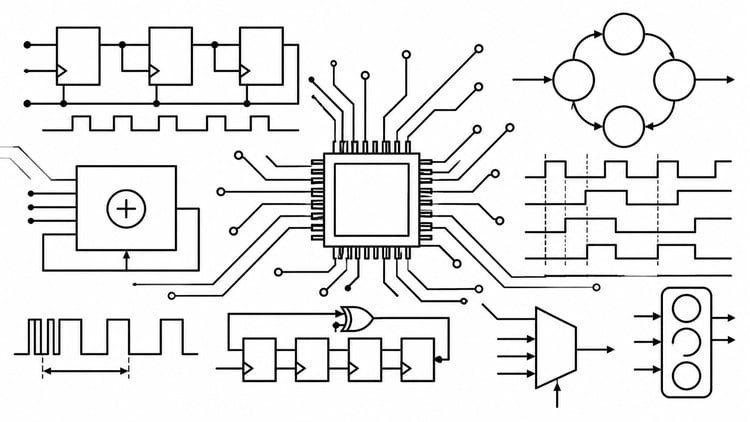
Take your Verilog HDL skills to the next level by learning how to design sequential digital circuits, counters, finite state machines, and timing-related components. This course builds on the fundamentals of digital logic and introduces important RTL design techniques used in FPGA and ASIC development.
Sequential logic is a core part of digital hardware design. Registers store information, counters track events, finite state machines control multi-step operations, and timing analysis helps engineers evaluate whether a design can operate reliably at its target clock frequency.
What you will learn
Understand registers, latches, and flip-flops and describe them using Verilog HDL.
Apply blocking and nonblocking assignments appropriately.
Implement synchronous and asynchronous set and reset logic.
Design up/down counters, modulus counters, BCD counters, and timer circuits.
Understand pulse width modulation (PWM), duty cycle, and counter-based PWM generation.
Explore linear feedback shift registers (LFSRs) and feedback logic.
Analyze finite state machines, including Mealy and Moore models.
Implement FSMs using state registers, transition logic, and output logic.
Understand ASM charts and FSM-based applications such as traffic light controllers.
Learn button debouncing concepts for reliable digital inputs.
Understand setup time, hold time, clock-to-Q delay, and clock skew.
Explore metastability and synchronizer circuits.
Interpret FPGA timing reports using AMD Xilinx Vivado.
Understand clock generation using Vivado's Clocking Wizard.
Who should take this course?
This course is intended for electronics and electrical engineering students, aspiring RTL design engineers, FPGA developers, VLSI learners, and engineers who want to strengthen their understanding of sequential logic design.
Basic digital logic and introductory Verilog HDL knowledge are recommended. Learners should be comfortable reading simple Verilog modules before starting.
Learn through practical digital design concepts
The lectures cover the principles behind counters, PWM generators, FSM-based controllers, sequential circuit timing, and clocking resources. You will build a stronger understanding of how sequential RTL is structured and how timing considerations influence digital hardware implementation.
Continue your RTL design journey
After completing this course, you will be better prepared to explore more complex RTL projects, verification methodologies, FPGA applications, and advanced VLSI design concepts.
Start strengthening your sequential design skills with Eddin VLSI Labs.
Learn. Design. Verify.
What you'll learn
- Design sequential circuits using Verilog HDL, including registers, latches, flip-flops, and synchronous and asynchronous resets.
- Implement up-down counters, modulus counters, BCD counters, timers, PWM generators, and linear feedback shift registers (LFSRs).
- Analyze and implement Mealy and Moore finite state machines for control applications such as traffic light controllers.
- Understand setup time, hold time, clock skew, metastability, synchronizers, and FPGA timing reports using Vivado.
Before you begin
- Basic knowledge of digital electronics and logic gates is recommended.
- Familiarity with introductory Verilog HDL, including modules, ports, and basic procedural blocks, is helpful.
- A computer is recommended for practicing Verilog examples and simulations.
- AMD Xilinx Vivado is useful for following the FPGA timing analysis and clocking demonstrations. Installation requirements depend on your system.
Who this is for
- Electronics, Electrical, ECE, and EEE students who want to advance their Verilog HDL skills.
- Beginners who have completed a basic Verilog or digital logic course.
- Aspiring RTL design engineers preparing for FPGA and VLSI design roles.
- Learners interested in sequential circuit design, counters, PWM, and finite state machines.
- Engineering graduates preparing for entry-level digital design interviews.
- FPGA enthusiasts who want to understand sequential RTL design and basic timing analysis.
How do you feel about this course?
Share your reaction. Select one emoji to leave or update your rating.
Please wait 30 seconds to explore this course.
This course opens on an external website.
Join the conversation
Share a thought or question. No account required.
Be the first to share your thoughts.