 COURSE PREVIEW
About this course
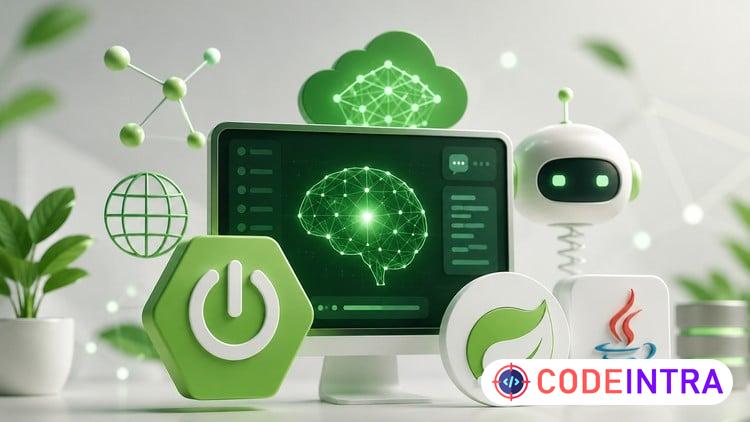
Spring AI 2: Build Production-Ready AI Applications with Java & Spring Boot
Artificial Intelligence is transforming software development, and Spring AI 2 brings enterprise-grade AI capabilities directly into the Spring ecosystem. This course is designed for Java developers, Spring Boot developers, and software architects who want to build modern AI-powered applications using Large Language Models (LLMs), Retrieval-Augmented Generation (RAG), AI Agents, Model Context Protocol (MCP), multimodal AI, and production-ready architectures.
Starting with the fundamentals, you'll learn how to integrate leading AI models such as OpenAI, Gemini, Anthropic Claude, Ollama, and Azure OpenAI into Spring Boot applications using Spring AI 2. You'll then progress to advanced enterprise topics including vector databases, document ingestion pipelines, metadata filtering, observability, security, knowledge graphs, and multi-agent orchestration.
Unlike theory-only courses, every lesson is backed by hands-on projects, real-world examples, and production best practices that you can immediately apply in your own applications.
By the end of this course, you'll have the skills to design, build, deploy, and monitor intelligent Spring Boot applications that are scalable, secure, and enterprise-ready.
What You'll Learn
Build AI-powered applications using Spring AI 2
Integrate OpenAI, Gemini, Claude, Ollama, and Azure OpenAI
Create conversational AI with Chat API and Streaming
Implement Tool Calling and Function Calling
Build AI applications with persistent Chat Memory
Develop Retrieval-Augmented Generation (RAG) applications
Perform Metadata Filtering for accurate document retrieval
Build ETL pipelines for document ingestion
Process PDFs, Word documents, HTML, Markdown, and websites
Build Vision and Multimodal AI applications
Convert Speech-to-Text (STT) and Text-to-Speech (TTS)
Design Multi-Agent AI systems
Protect applications from Prompt Injection attacks
Monitor AI applications using Observability and Tracing
Build Knowledge Graph RAG solutions
Integrate external tools using Model Context Protocol (MCP)
Develop reusable AI Agent Skills
Deploy AI applications to production
Course Curriculum
Path 1 – Beginner
Build a strong foundation with Spring AI.
Lesson 01: Core Chat API
Lesson 02: Streaming Responses
Lesson 03: Tool Calling
Lesson 04: Chat Memory
Lesson 05: Retrieval-Augmented Generation (RAG)
Path 2 – Intermediate
Learn enterprise AI application development.
Lesson 06: Metadata Filtering
Lesson 07: ETL & Document Ingestion
Lesson 08: Vision & Multimodal AI
Lesson 09: Audio (Speech-to-Text & Text-to-Speech)
Lesson 10: Multi-Agent Orchestration
Path 3 – Advanced
Master production-ready AI architecture.
Lesson 11: Security & Prompt Injection Defense
Lesson 12: Observability & Monitoring
Lesson 13: Knowledge Graph RAG
Lesson 14: MCP (Model Context Protocol) Integration
Lesson 15: Agent Skills & Intelligent Workflows
What you'll learn
- Build AI-powered Java applications using Spring AI 2 by integrating Large Language Models (LLMs) into Spring Boot projects.
- Integrate popular AI providers such as OpenAI, Anthropic, Google Gemini, Ollama, and Azure OpenAI using Spring AI's unified API.
- Implement Retrieval-Augmented Generation (RAG) by connecting vector databases, embedding models, and document retrieval to create context-aware AI applications.
- Develop AI chat applications with prompt engineering, conversation memory, streaming responses, and structured outputs.
- Use Spring AI Advisors and Tools to enable function calling, tool execution, and intelligent workflows within AI applications.
- Work with embeddings and vector stores to perform semantic search, document indexing, and similarity-based retrieval.
- Build multimodal AI applications that process text, images, and other supported input types using Spring AI.
- Apply production-ready best practices for AI application development, including configuration, testing, observability, error handling, and security.
Before you begin
- Familiarity with Java and Spring Boot fundamentals, including dependency injection and REST APIs.
- An API key for at least one supported AI provider (such as OpenAI, Google Gemini, Anthropic, or Azure OpenAI) or a local Ollama installation for running open-source models.
- No prior experience with Artificial Intelligence, Machine Learning, or Large Language Models is required—these concepts will be introduced throughout the course.
Who this is for
- Java developers who want to build AI-powered applications using Spring AI 2.
- Backend developers interested in implementing AI features such as chatbots, RAG, embeddings, and function calling.
- Developers transitioning into AI application development without requiring a Machine Learning background.
- Architects and technical leads exploring production-ready AI solutions for Java and Spring-based systems.
How do you feel about this course?
Share your reaction. Select one emoji to leave or update your rating.
Please wait 30 seconds to explore this course.
This course opens on an external website.
Join the conversation
Share a thought or question. No account required.
Be the first to share your thoughts.